
Home / Home Assistant
Home Assistant,
set up properly.
Above the switch panels sits a local Home Assistant server, commissioned and customised by us. It is what turns separate products — Zigbee switches, cameras, a solar inverter, a split AC, white goods — into one dashboard with one login, running on hardware in the building rather than in somebody else's cloud.
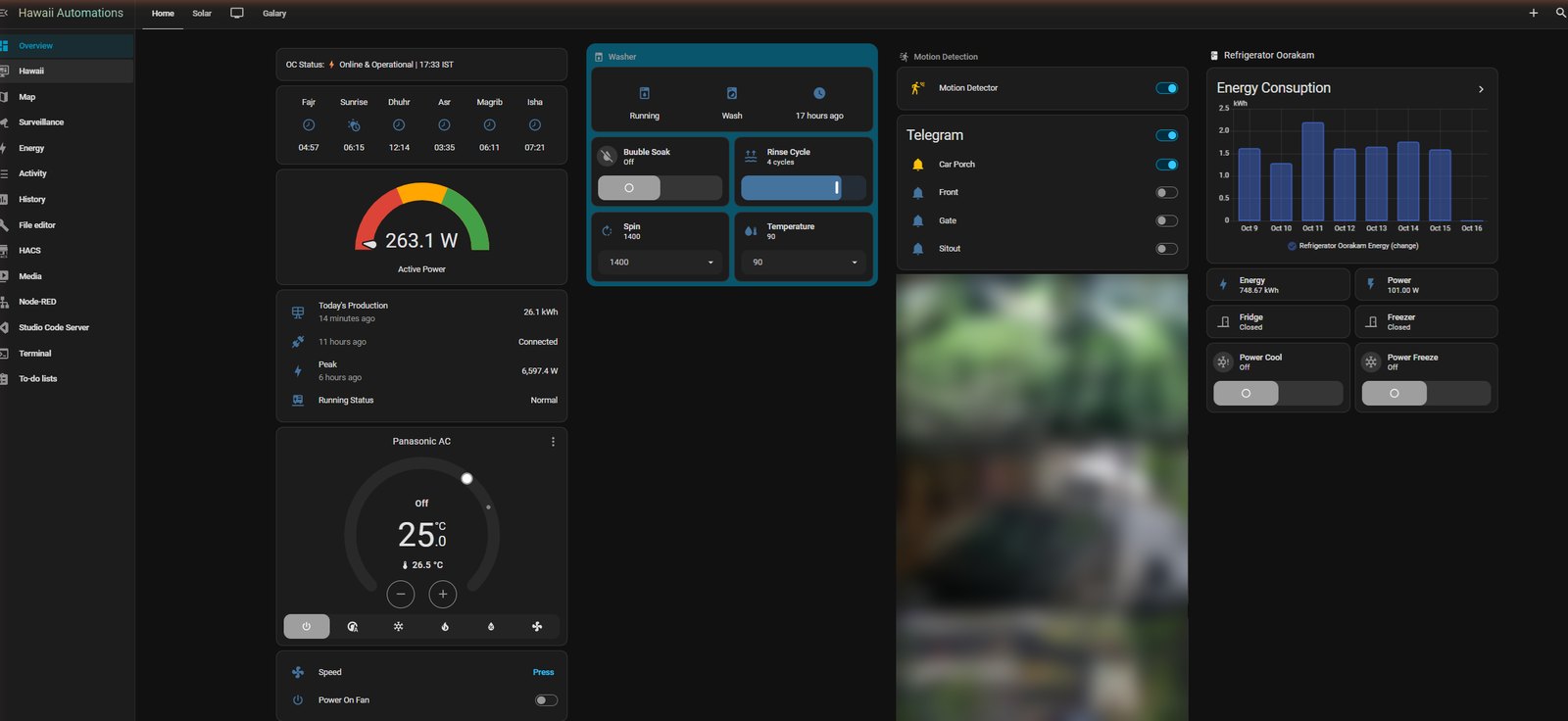
What gets brought in
One dashboard over everything on site.
Lighting & power
Every Hawaii key, dimmer, curtain key and socket through the Zigbee gateway, grouped by room with scenes.
Solar & energy
Inverter production, PV string current and voltage, three-phase line voltages, daily and lifetime yield, per-appliance consumption.
Climate
Split and ducted AC as full thermostat cards — setpoint, mode, fan and swing — with room temperature and humidity.
Cameras & entry
NVR and IP camera feeds, the H1X door station, motion events and snapshot alerts on a dedicated surveillance view.
Appliances
Connected washers, refrigerators and water heaters — cycle state, remaining time, door state and energy history.
Local extras
Prayer times, weather, presence and location, to-do lists and household routines built to your own request.
What we deliver
The engagement.
We deliver the server, not just the switches — installation, integration, dashboard design and the automation logic behind it, then hand over a documented system you can keep extending.
Server & network
Home Assistant installed on dedicated local hardware with a static address, UPS-backed power, VLAN separation for cameras and IoT, and secure remote access over your own domain with TLS. No dependency on a vendor cloud for day-to-day control.
Integration
Zigbee coordinator paired to the Hawaii mesh, then every other system onboarded — inverter, NVR, air-conditioning, white goods, energy meters and the door station. Entities are renamed, grouped by room and given the right device classes so the dashboards and energy reports actually add up.
Dashboard design
Custom views per audience — a family overview, a solar view, surveillance, energy, history and a map. Card layouts, icons and artwork are designed to match the project, and the same dashboards render on the 4″, 8″ and 10.1″ wall panels.
Automation & alerts
Routines built in Home Assistant and Node-RED: presence-driven lighting, away mode, tank and pump control, AC scheduling, leak and smoke cut-offs. Push notifications go to Telegram or the mobile app, switchable per zone so the household can tune the noise.
Handover & support
File editor, code server and terminal access left in place, HACS configured for community add-ons, configuration backed up, and a walkthrough with you. Remote support and change requests under an optional maintenance agreement.
Why local
It keeps working when the internet does not.
Home Assistant sits over the top of the Hawaii hardware rather than replacing it. The panels keep working on the Zigbee mesh if the server is down, and third-party equipment already on site can usually be adopted instead of ripped out.
- Control and automations run on site, not in a vendor cloud
- Switch panels fall back to the Zigbee mesh independently
- Camera video stays on your own network
- Existing equipment adopted where it supports a standard
- Configuration backed up and handed over to you
Already have the hardware?
We take on Home Assistant commissioning for existing installations too — including systems that were not supplied by us.